
E.ON Hungária's CEO told the Portfolio Energy Investment Forum 2026 that 2026's price spikes, negative prices and a near-brownout are not accidents but symptoms of an energy system in transition. His prescription: invest in the grid, end the cross-subsidy behind Hungary's household price cap, and make flexibility pay.
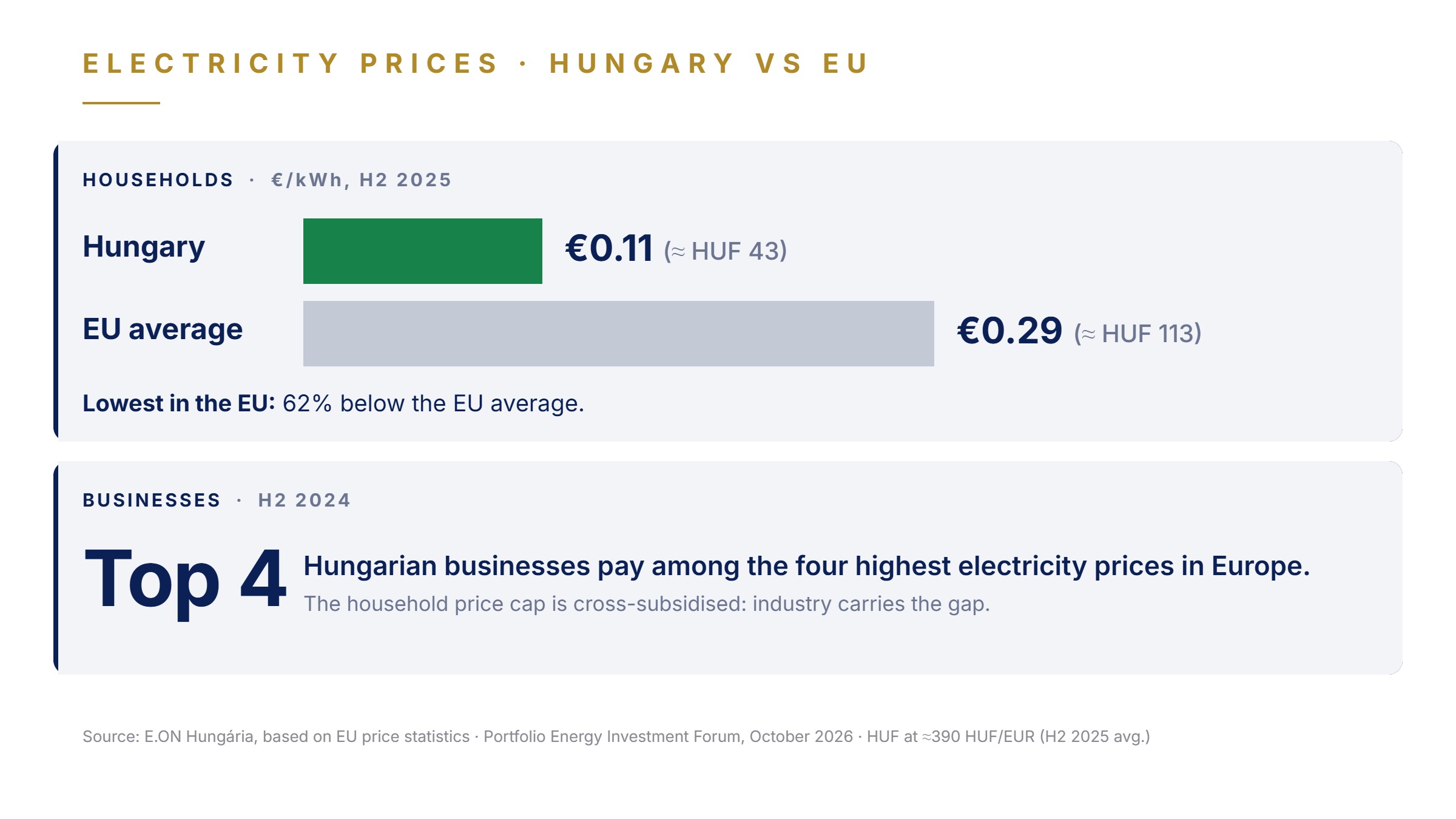
Electricity prices: Hungary vs EU Data: E.ON Hungária
For the fourth year running, Dr. Guntram Würzberg, chairman and CEO of E.ON Hungária, took the stage in Budapest to describe the state of the energy sector. And for the fourth year running, he opened with a challenge nobody had been discussing twelve months earlier.
This year's challenge was the sheer volatility of the system itself. "What we see here is a symptom of a system in transition," Mr. Würzberg said. The energy transition, he argued, is no longer something the industry talks about. It is happening, and its growing pains now show up in prices, in grid stress and in the bills of Hungarian businesses.
A year of extremes
"Energy is a security question again," read the title of Mr. Würzberg's first slide, and the numbers behind it were stark. Hungarian wholesale power for delivery in 2027 has risen 50% since January to €150/MWh, a level last seen in early 2023. European gas (TTF) is up 145% over the same period, with the Strait of Hormuz closed and German storage low.
He cited EU Energy Commissioner Dan Jørgensen: since the Iran war, the EU has paid €100 billion extra for energy imports and received not one extra molecule for it. Whether the coming winter is hard or mild may come down to El Niño. "So what should we rely on?" Mr. Würzberg asked. Hope, he implied, is not an energy security strategy.
At home, the extremes cut both ways. "Same country. Same grid. Four months apart," as one slide put it:
- April, midday: prices fell to −€500/MWh. Producers paid buyers to take their electricity; there was too much power and nowhere to put it.
- August, evening: with the Danube too low to cool the Paks nuclear plant, system operator MAVIR asked the country to cut consumption between 5 and 10 pm. Hungary came close to a brownout, with distributors like E.ON near the point of disconnecting customers.
The government, MAVIR and the energy companies went into crisis mode, and the appeal worked. But Mr. Würzberg stressed who actually responded: mostly industrial customers. Households had no financial incentive to change their behaviour, a point he would return to.
The solar paradox
Hungary has become, in Mr. Würzberg's words, a world champion in renewable power. In 2025, solar supplied 27% of the country's electricity, the highest share in the world according to Ember's Global Electricity Review 2026, up from just 2% in 2018. Installed solar capacity now stands at 8,700 MW.
The rest of the system has not kept pace. Storage capacity is still below 1,000 MW, and wind stands at only about 330 MW. Above all, the grid that all this generation must connect to is, as he put it, "from yesterday".
That is not because network operators have stopped investing, Mr. Würzberg insisted. It is because policy put the focus on generation first and on connecting it second. "The grid is the backbone of the energy system," he said, "not its background." The problem is not uniquely Hungarian; it applies across Europe.
Half the country's grid, and flexibility beyond batteries
E.ON runs roughly half of Hungary's power distribution network. Mr. Würzberg gave the key figures:
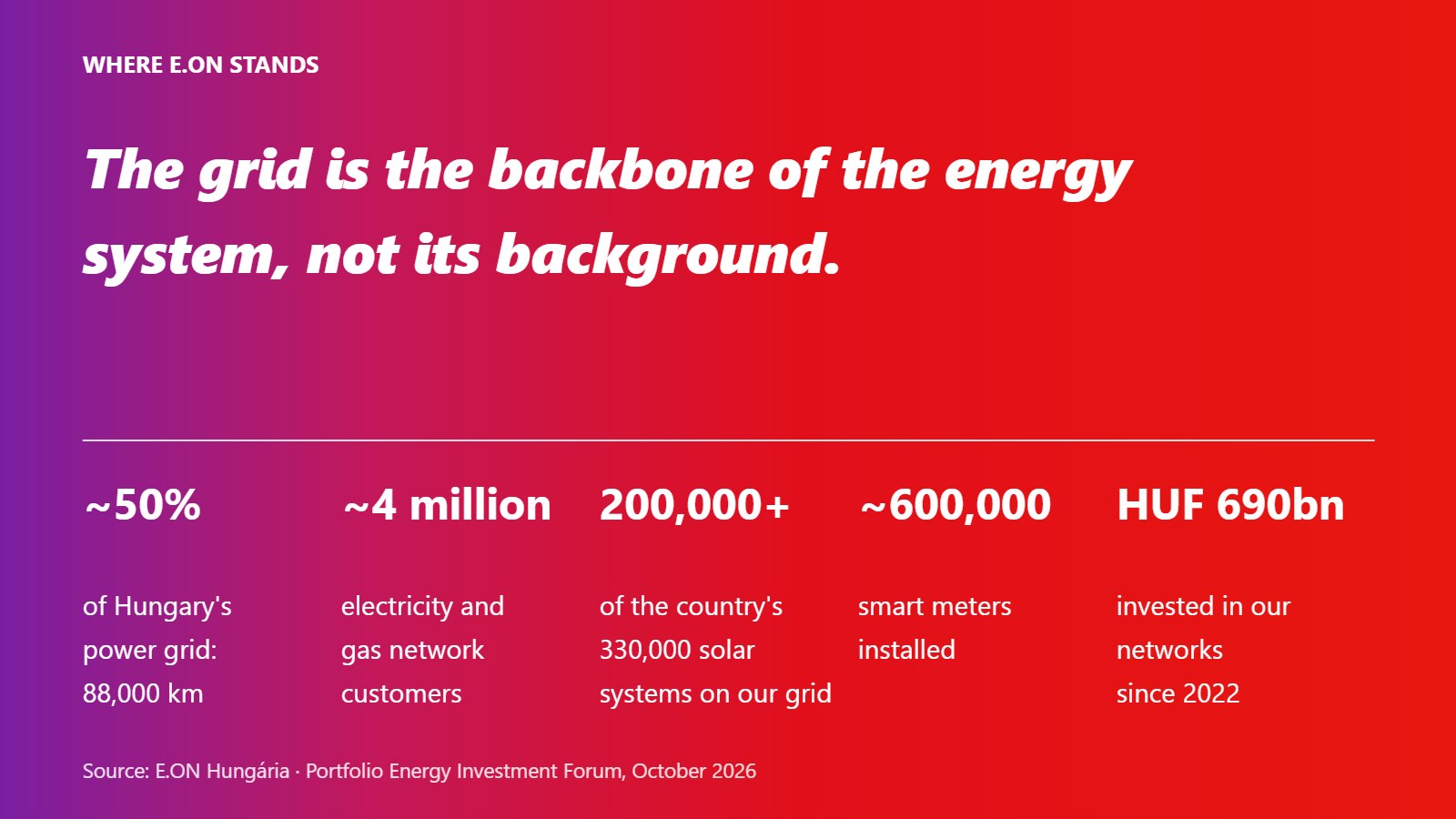
Building a new grid will take time, he said, but the company is also working on the demand side. Since this year, E.ON's industrial and SME customers can choose among several time-of-use tariffs that make power cheaper at the right hours. For large industrial customers, E.ON offers bigger PV installations and district-scale solutions. These let businesses decide for themselves when and how they use energy, making them less exposed to grid constraints and price swings.
That, Mr. Würzberg argued, is what flexibility really means. Batteries are part of it, and he noted a battery boom in Germany reminiscent of the earlier rush into wind. But tariffs, metering and customer-side solutions matter just as much.
EU money is welcome, but it comes with strings
Mr. Würzberg called the government's success in bringing home EU Recovery and Resilience Facility funds "a breakthrough for the grid" and a good, hard-won decision. E.ON will receive HUF 230 billion for grid development, nearly half of Hungary's national envelope for this purpose, plus HUF 13.5 billion for smart meters. The programme is set to add 2,323 MW of new connection capacity for renewables by 2030 and 237,000 more smart meters by the end of 2028.
He was equally clear about its limits. The funds are one-off, capped and earmarked for grid investments that enable renewables, such as connecting the roughly 4,000 MW of wind capacity the government plans to tender by 2030. And they cover only a quarter of what E.ON plans to spend: "For every four forints we plan to invest, EU funds bring one." The other 75% is the company's own money, which needs a predictable, investment-friendly framework.
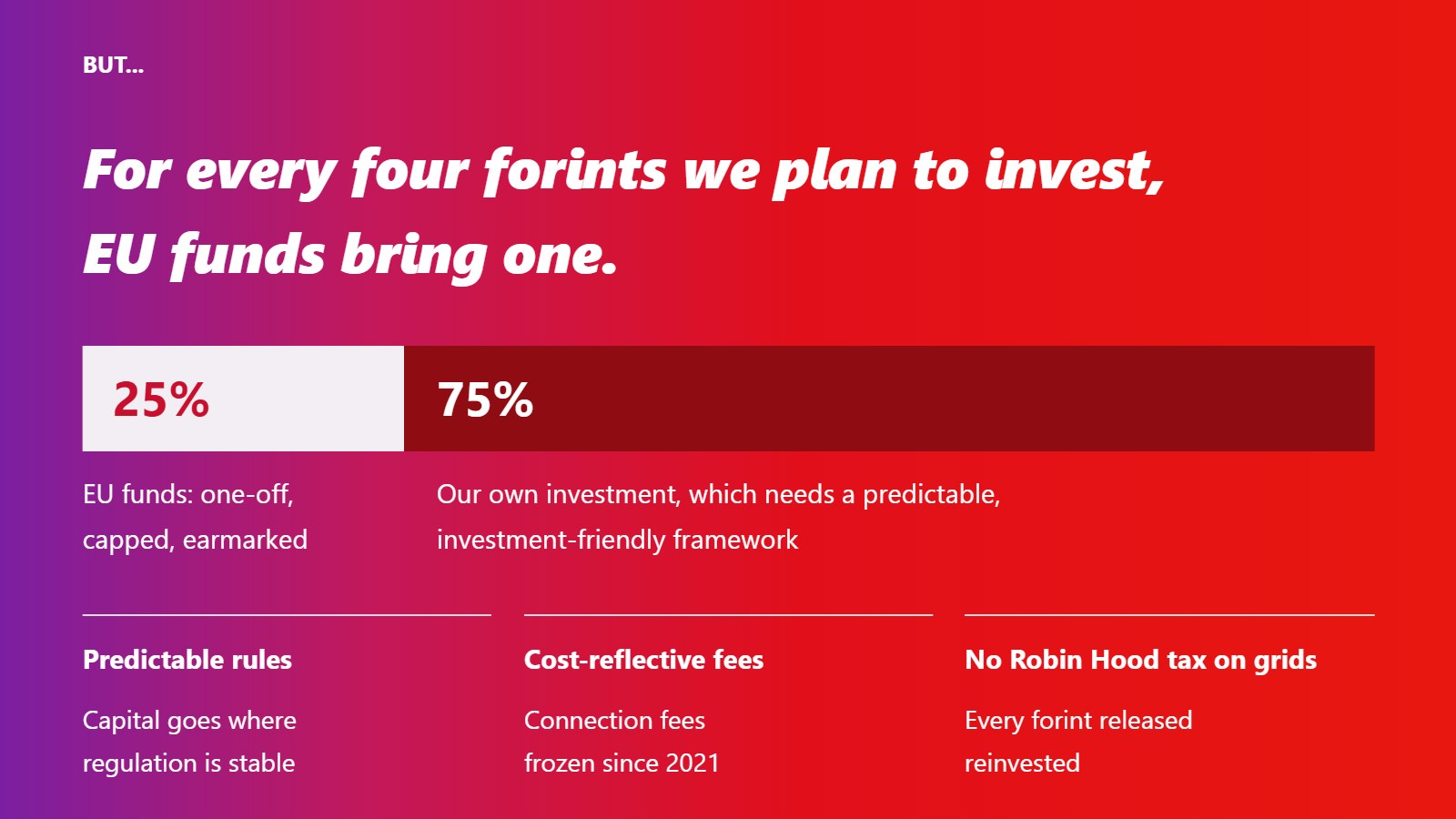
That framework, he said, rests on three conditions:
- Predictable rules. Capital goes where regulation is stable.
- Cost-reflective fees. Grid connection fees have been frozen since 2021.
- No Robin Hood tax on grids. A new rule lets grid companies offset up to 80% of the tax through reinvestment, and E.ON pledges to reinvest every forint released. But the rule has not yet been implemented, so the company is still paying tax that could be going into the network.
The white elephant in the room
Mr. Würzberg saved his sharpest point for the household price cap, the rezsicsökkentés. Hungarian households pay the lowest electricity price in the EU: €0.11/kWh against an EU average of €0.29 (H2 2025). Hungarian companies, meanwhile, pay among the four highest prices in Europe (H2 2024), and they are increasingly asking why.
"The cost of energy doesn't disappear. It moves," read his slide. The gap exists not because anyone is making excess profit, he said. It is that the costs of the system are cross-subsidised: industry is paying for the gap between what households are charged and what their power actually costs. That weighs directly on Hungarian companies' competitiveness.
He acknowledged that this is a politically sensitive question, but insisted it can be solved. "It's not about whether we do it or not, it's about how we do it," he said. Many people, including some in the room, do not need support with their energy bills. "So why is there a protection of kilowatt hours instead of families?"
E.ON's proposal, presented as "Rezsicsökkentés 2.0", which the company says it is ready to work out with the government and the ministry, is to protect families, not kilowatt-hours. A reformed system should be:
- Targeted: support goes to those who need it, so protection follows the family, not the size of the home.
- Fair: everyone who uses the grid helps pay for it, so costs stop landing on businesses.
- Smart: prices reward saving and using power when it is plentiful, which smart meters now make possible.
This would also restore the price signal that was missing in the summer, when households had no reason to shift their use away from the evening peak.
Three tasks for the years ahead
Mr. Würzberg closed on an upbeat note. When he started his career decades ago, he recalled, energy was considered a boring business; ambitious graduates went into automotive or law. That has changed. Agreeing with an earlier speaker, he told the audience they could be proud to work in the industry at a moment like this.
His agenda for that moment came down to three themes:
- Build the grid.
- Price it fairly.
- Unlock flexibility.
This article reflects what EnergyHeadhunter.de, the energy division of ExecutiveHeadhunter.com, understood from Dr. Guntram Würzberg's presentation at the Portfolio Energy Investment Forum 2026, based on our own notes and his presentation slides.
More from EnergyHeadhunter
Hiring for the energy transition?
EnergyHeadhunter.de finds senior specialists and executives across the energy value chain, from grid and storage to data centers.


Driving the Green Transition

International Executive Search

© 2018 The Executive Headhunter Kft. All rights reserved. · Privacy Policy
The Executive Headhunter Ltd. · Tax number: 26346625-2-07 · Company reg. no.: 07-09-029020 · Permit number: FE/12/1830-3/2022