
At CATL Tech Day in Budapest, Wood Mackenzie forecast a tenfold rise in Europe's energy storage market by 2035, with Central and Eastern Europe offering the best returns. CATL made its case with sodium-ion batteries and an R&D engine few rivals can match.
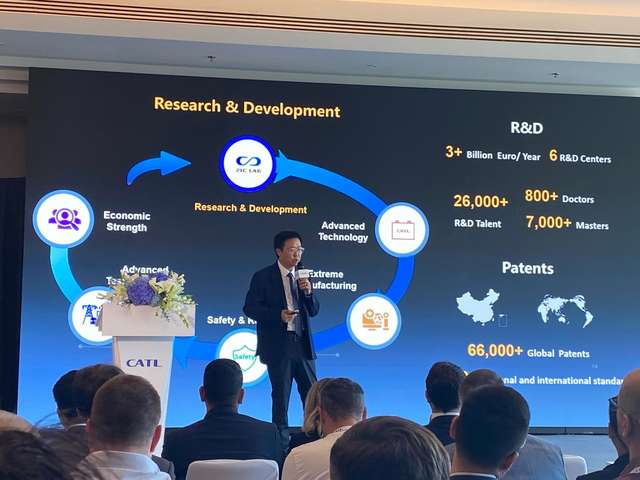
CATL R&D: €3bn+ a year · 26,000+ R&D talent · 66,000+ global patents CATL Tech Day, Budapest
On September 28th, CATL filled a Budapest conference hall with developers, investors and grid engineers for its Tech Day, held under the theme "Watts to Worth". The message of the day was simple: the market, the money and the technology for battery storage are all arriving in the region at once.
A tenfold market by 2035
Dr. Alex Cipolla, senior research analyst at Wood Mackenzie, opened with the headline number. Europe's energy storage fleet is forecast to grow from 51 GW and 93 GWh in 2025 to 339 GW and 966 GWh by 2035: a rise of 570% in power and 937% in energy.
The biggest brake on that growth, he said, is not demand. It is grid connection and the fees that come with it.
The East pays best
Batteries earn money on the gap between cheap and expensive hours, and that gap is widest in the East. In the first half of 2026 the average two-hour spread on the day-ahead market reached:
- Romania: about €165/MWh
- Poland: about €157/MWh
- Slovakia: about €152/MWh
By comparison, France stood at about €112/MWh, Great Britain at €77 and Finland at €60. Add capacity markets and tenders, and few regions in the world offer both strong merchant and contracted revenue. Hungary was singled out as an untapped market: the spreads are there, the project pipeline is not yet.
Lithium swings, sodium doesn't
Wesley Gu, CATL's technical leader for Hungary, the Czech Republic and Bulgaria, explained why sodium-ion is moving from the lab to the grid. Lithium carbonate went from about RMB 600,000 a tonne in November 2022 to RMB 59,000 in June 2025, then rebounded to RMB 209,000 in May 2026. "No 20-year project can budget on that," his slide read.
Supply is concentrated too: the top three countries hold 74.2% of lithium reserves, and China refines about 70%. Sodium is roughly 1,000 times more abundant. CATL's sodium-ion cells have already covered 180,000 km in Chery passenger cars, its Naxin brand launched in April 2025, and storage deliveries have now reached GWh scale.
R&D at a scale few can match
CATL's research engine was the backbone of the day. The company runs a cycle from research and advanced technology through extreme manufacturing to safety and reliability, led by its 21C Lab. The numbers behind it:
- Investment: more than €3 billion a year, across six R&D centres.
- People: over 26,000 R&D staff, including 800+ PhDs and 7,000+ master's graduates.
- Patents: more than 66,000 worldwide.
- Validation: a grid integration lab that simulates complete plants, from inverter controls to the power plant controller, before anything is built.
Mohammed Qudaih, CATL's solution director for Germany, made the same point from the field: the best battery and the best inverter do not make the best plant unless someone engineers them as one system, black start and grid code included.
The risks investors still carry
The financing session was a reality check. Logistics shocks from Suez to Hormuz, retroactive subsidy cuts and a wave of bankrupt Chinese solar manufacturers have all hit real projects. Solar module warranties can be reinsured; batteries cannot yet. And headline returns of 15–30% shrink fast once bank debt and revenue sharing enter the structure.
What it means
The market, the spreads and the technology are ready. The bottlenecks are grid access, bankability and the people who can engineer, finance and operate storage as one system. Those are exactly the profiles the region's developers, utilities and investors are now competing for.
This article reflects what EnergyHeadhunter.de, the energy division of ExecutiveHeadhunter.com, understood from the presentations at CATL Tech Day in Budapest on September 28th 2026, based on our own notes and the presentation slides. Thank you to CATL for a sharp, data-driven day.
More from EnergyHeadhunter
Hiring for the energy transition?
EnergyHeadhunter.de finds senior specialists and executives across the energy value chain, from grid and storage to data centers.


Driving the Green Transition

International Executive Search

© 2018 The Executive Headhunter Kft. All rights reserved. · Privacy Policy
The Executive Headhunter Ltd. · Tax number: 26346625-2-07 · Company reg. no.: 07-09-029020 · Permit number: FE/12/1830-3/2022